
Table of Contents
- Brighton Architecture: The Stories, Styles, Landmarks and Local Insights
- What defines Brighton’s Regency architecture?
- Which Victorian and Edwardian buildings shape Brighton’s skyline?
- How has modern and contemporary architecture changed Brighton?
- What are the best Brighton architecture walks to discover local stories?
- Who are the key architects behind Brighton’s built heritage?
- How are Brighton’s historic buildings protected and what’s next for them?
- Conclusion
- Useful Reads
This blog post may contain affiliate links. As an Amazon Associate I earn from qualifying purchases.
Brighton Architecture: The Stories, Styles, Landmarks and Local Insights
Last checked: 23 February 2026
Brighton’s buildings tell a lively story of seaside fashions, royal tastes and constant reinvention, from smooth stucco terraces to bold modern interventions on the promenade. This guide breaks down the city’s main architectural eras: Regency, Victorian and Edwardian, Art Deco and contemporary. You can spot the differences on the street with clear visual cues, short walking routes and practical tips to help you read Brighton’s architecture like a local. Along the way, you’ll find concise profiles of key sites and architects, curated walks highlighting instructive examples, and local insight to enrich your exploration on foot.
Brighton’s rise as a popular seaside resort in the early 19th century shaped its unique civic character and urban growth, setting it apart from other towns of the time.
What defines Brighton’s Regency architecture?
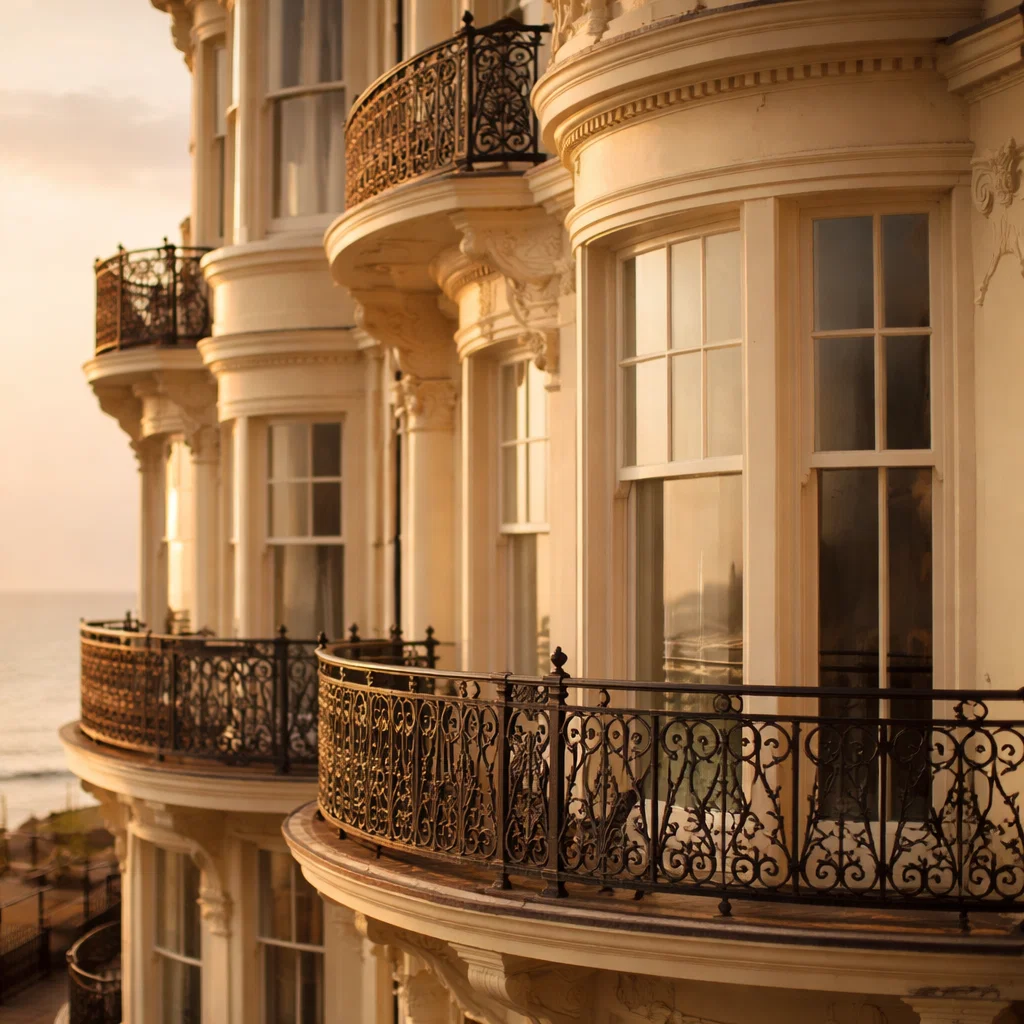
Regency architecture here is a coastal take on classical style: graceful proportions, repeated bays and decorative details that signal refinement. Think long stucco terraces, tall sash windows and delicate iron balconies arranged so whole streets feel like a single composed picture. This approach shaped neighbourhoods such as Brunswick Square in Hove and Kemp Town in Brighton. Brunswick Square was designed by Amon Wilds and Charles Busby and built between 1825 and 1830. Spotting these features on a walk reveals the period’s focus on proportion, ornament and a civic sense of sweep.
The key Regency features to look for:
- Stucco Facades: Smooth, painted render that gives a classical, almost temple-like finish.
- Tall Sash Windows: Narrow, vertically proportioned windows often divided by slim glazing bars.
- Ironwork Balconies: Fine cast-iron verandas and balcony railings on seafront terraces.
- Terraces and Crescents: Continuous rows and curved terraces that frame garden squares.
- Colonnades and Pilasters: Classical columns or flat pilasters marking entrances and doorcases.
Use these visual cues as a simple language while walking. Later sections give emblematic Brighton examples and explain why they matter.
How does the Royal Pavilion show Indo‑Saracenic influence?
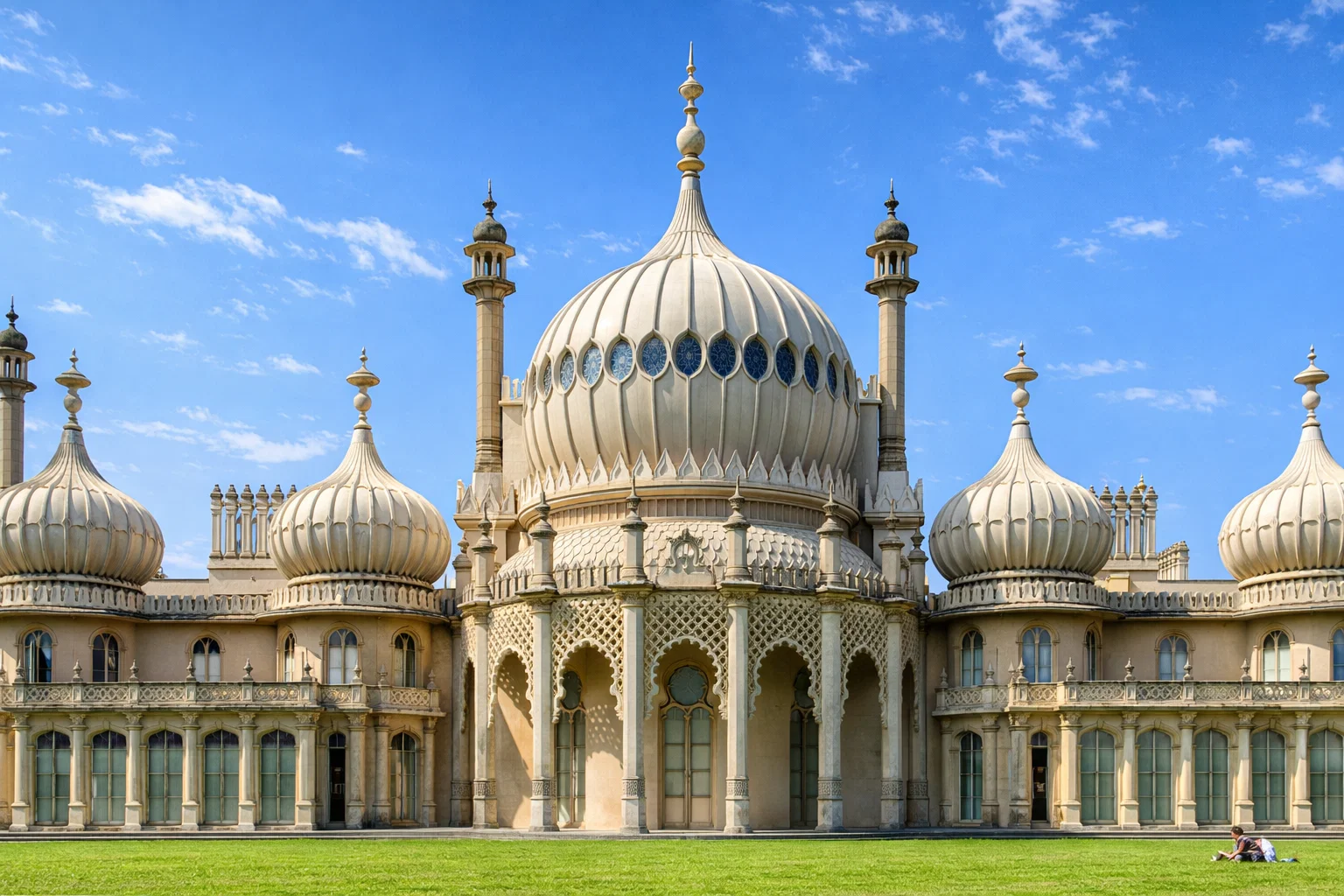
The Royal Pavilion stands out as an extravagant Indo‑Saracenic statement that brought exotic theatricality to British seaside architecture. Its onion domes, minaret-like towers and lavish interiors reflect early 19th‑century tastes for the exotic, realised under royal patronage and reshaped during the Regency. John Nash’s remodelling fused theatrical forms with sumptuous decoration, producing an exterior silhouette and interior scheme unique in Brighton city centre near Old Steine. Visitors often notice the contrast between the Pavilion’s Eastern‑inspired shell and its detailed chinoiserie and neoclassical interiors. This shows how Brighton became a fashionable resort for high society.
The Pavilion helped cement Brighton’s reputation as a stylish Regency resort, attracting visitors from across Britain and beyond. Its royal connections and unique design made the city a must-visit destination for the fashionable elite of the time.
Architecture here was designed to bring people together and create a lively public scene. The Pavilion is a perfect example of how buildings set the stage for social life in Brighton.
Why are Brunswick Square and Kemp Town key Regency examples?
Brunswick Square in Hove and Kemp Town in Brighton demonstrate Regency urban planning at its most composed: ordered terraces, communal garden squares and matching façades that create a dignified streetscape. These developments pair private homes with shared green space and use repeated bay units and stucco finishes to deliver visual unity along the seafront and nearby streets. Architects of the period cared about proportion, views and the social uses of space. Walking these squares shows how design promoted genteel seaside living. The regularity of terraces also makes them photogenic and easy to compare for visitors studying period composition.
Practical tip: morning light along the seafront brings out façade relief and ironwork. Quieter weekdays let you linger over doorcases and cornices without the crowds. Mapping these areas first gives you a vocabulary you’ll recognise across Brighton & Hove.
Which Victorian and Edwardian buildings shape Brighton’s skyline?
Victorian and Edwardian work added engineering confidence and decorative variety to Brighton’s earlier Regency base. Gothic Revival churches, pleasure piers and grand hotels became visible signs of civic pride. Where Regency favoured classical restraint, the Victorian era embraced ornate stonework, iron structures and eclectic façades driven by new materials and technologies. Edwardian buildings kept the craftsmanship while adapting to changing public uses. The skyline today layers domestic terraces with showpiece civic and leisure architecture.
Key Victorian and Edwardian landmarks and why they matter:
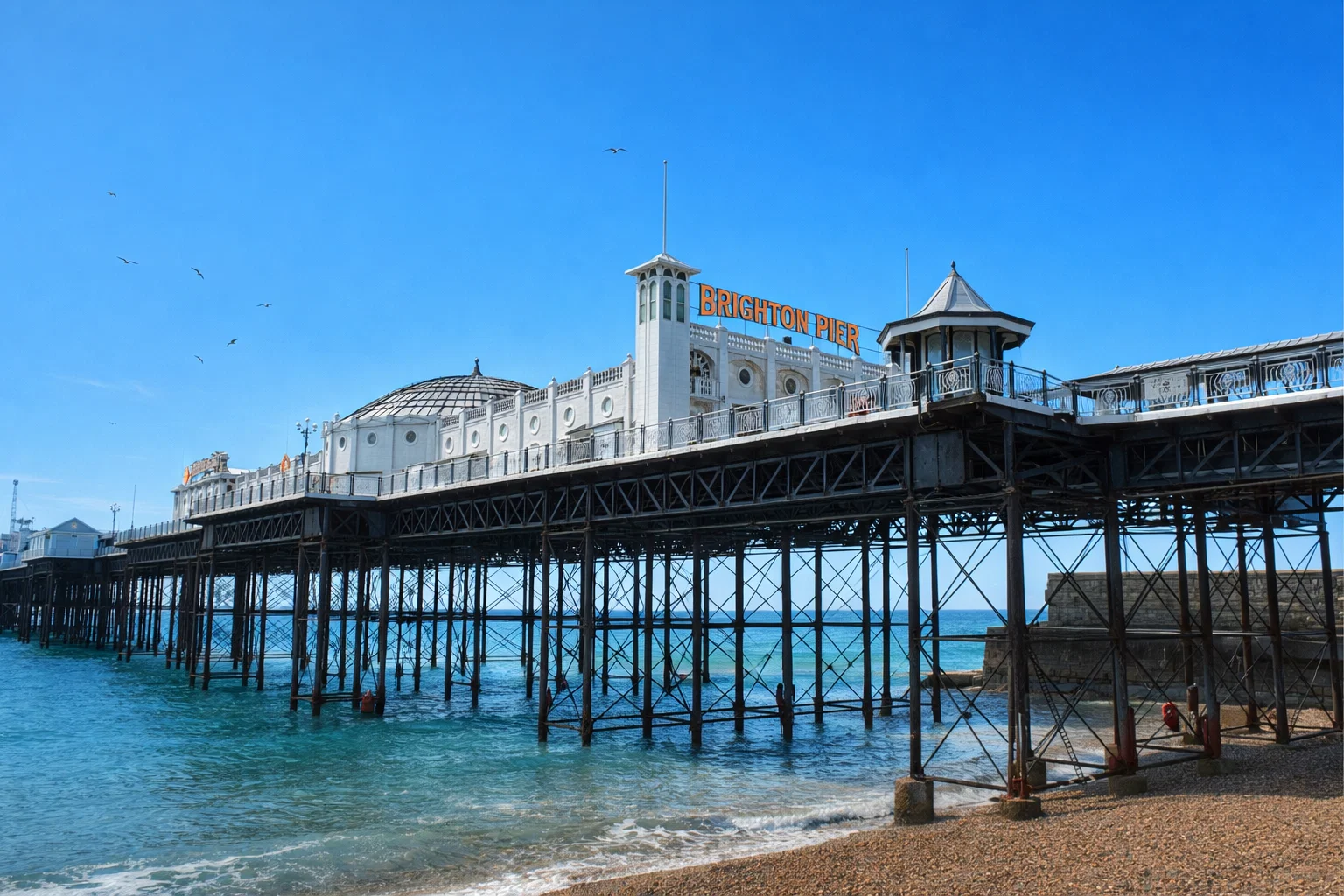
- Brighton Palace Pier: A Victorian engineering achievement and the seafront’s entertainment hub.
- The Grand Brighton (often called The Grand Hotel): A large, opulent hotel that signals Victorian hospitality and civic ambition.
- St Bartholomew’s Church: A Gothic Revival church that anchors Brighton’s religious and architectural history.
- Duke of York’s Picturehouse: An Edwardian cinema opened in 1910, still operating and a fine example of early 20th-century leisure architecture.
These buildings show how industrial skill and leisure culture reshaped Brighton’s coast. The table below compares primary attributes to help you plan visits.
This compact comparison highlights differences of style and function and helps you pick stops for a walk focused on Victorian and Edwardian contrasts.
What makes Brighton Palace Pier and The Grand Brighton architecturally significant?
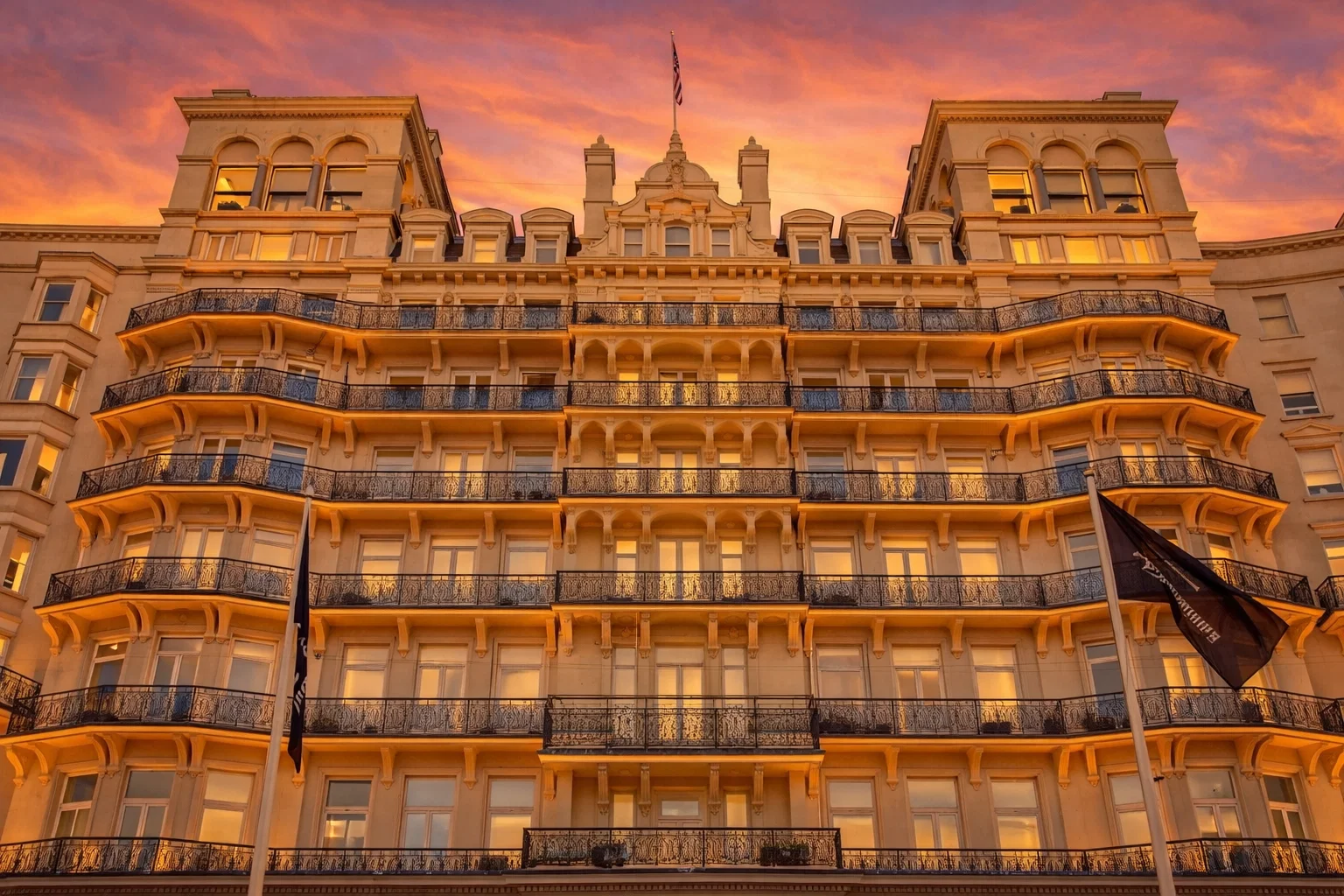
Brighton Palace Pier is a Victorian engineering solution turned cultural magnet. Ironwork, timber decking and ornament extend social life over the water and create a destination for promenading and amusements. The Grand Brighton, by contrast, is a statement of Victorian scale and luxury. Its façades and public rooms project the era’s confidence in grand hospitality. Together they show how Victorian architecture delivered spectacle and civic infrastructure for a growing seaside audience.
Look for material choices and spatial organisation that reveal the period’s priorities: durability, public theatre and facilities for mass leisure. Details like ticket kiosks, balustrades and hotel cornices help you trace technological and stylistic change.
How do St Bartholomew’s Church and Gothic Revival shape Brighton’s heritage?
St Bartholomew’s and other Gothic Revival buildings bring pointed arches, tracery, buttresses and vertical emphasis into Brighton’s mix. This 19th-century return to medieval forms was used for spiritual and civic statements. In Brighton these buildings often show dramatic scale and strong Victorian Gothic character, providing a striking contrast with nearby stucco terraces. When interiors are open you can see timber roofs, carved details and liturgical fittings that underline the movement’s aims. Spotting tracery patterns, hood moulds and lancet windows will help you tell Gothic Revival apart from other historic styles on a walk.
How has modern and contemporary architecture changed Brighton?
Modern and contemporary projects introduced new materials, cleaner forms and sometimes bold insertions that reinterpreted the seafront for late 20th and early 21st-century uses. Work ranges from Art Deco updates to striking modernist and recent interventions that altered sightlines and public access. These projects often sparked public debate about heritage and aesthetics while also creating new cultural facilities and visitor experiences. To understand modern interventions, pay attention to materials, scale and how new work converses with older streetscapes.
The section below profiles notable modern icons and shows how they fit into Brighton’s story, with an eye to visitor experience and public reaction. A short table then helps you weigh design intent, function and reception.
What’s the story behind Brighton Dome’s 20th-century interior updates?
The Brighton Dome’s interior shows how older buildings were updated to meet changing tastes and functional needs without replacing the whole structure. The major Art Deco refurbishment in 1934–35, led by architect Robert Atkinson, introduced stylish new decorative elements. Later, a significant refurbishment completed between 1999 and 2002 improved facilities for performances and audiences. If you’re interested in craftsmanship, look for mouldings, original light fittings and auditorium detailing that reflect these different periods of adaptation. The Dome’s layered history is a neat example of refreshing a civic building while keeping its cultural role intact.
Why are Embassy Court and the Brighton i360 seen as modern icons?
Embassy Court and the i360 offer two different modern responses to Brighton’s seafront. Embassy Court is a 1930s modernist block whose scale and horizontality challenged Regency proportions and provoked debate about modernism on the promenade. The i360, a slender viewing tower, reframes the skyline by offering a new way to experience coastal views. Together they show how modern architecture can challenge expectations and, at times, enrich a heritage setting, depending on design, materials and how people use the spaces.
These projects underline that modernity in Brighton is an ongoing conversation between design ambition, public feeling and the coastal landscape.
What are the best Brighton architecture walks to discover local stories?
Self-guided architecture walks stitch Regency elegance, Victorian spectacle and modern interventions into short, manageable itineraries that teach you to read the city. The best routes mix seafront landmarks with quieter streets where doorcases, ironwork and garden squares reveal construction methods and social history. Below are three curated walks with duration, highlights and accessibility notes. Each is easy to follow and ideal for photography, sketching or simply learning to spot architectural detail.
- Regency East Walk, 45–60 minutes: Explore Kemp Town’s terraces and garden squares, focusing on elegant stucco façades and iron balconies.
- Regency West Walk, 45–60 minutes: Discover Brunswick Square in Hove and surrounding streets, noting classical proportions and communal green spaces.
- Victorian & Edwardian Highlights, 90 minutes: Take in Palace Pier viewpoints, The Grand Brighton exteriors and nearby Gothic Revival churches.
- Modern Brighton Trail, 60 minutes: Spot Art Deco interiors, study Embassy Court façades and experience the i360 observation platform.
These itineraries are compact and flexible. Combine them into a half- or full-day plan to suit your pace and any accessibility needs.
How to experience the Regency East and West Walks and other trails?
The Regency East and West Walks work best as separate gentle loops, each focused on façades, garden squares and the Pavilion setting. Allow about 45 to 60 minutes for each at a relaxed pace. Begin near the Pavilion to read its exterior language, then follow the terraces, noticing stucco finishes, sash windows and repeating iron balconies. Pause at Brunswick Square or Kemp Town to study doorcases and cornices and to see how gardens mark the boundary between public and private space. Practical tips: choose morning or late-afternoon light for the best façade photography and plan café stops for comfort.
These concentrated routes make Regent-era design easy to recognise when you move into neighbouring streets.
Where are Brighton’s hidden architectural gems?
Look beyond the headline sites. Tucked lanes, secondary façades and lesser-seen institutional buildings reveal surprising detail. Keep an eye out for unusual fanlights, late-Victorian boundary walls or surviving Art Deco shopfronts behind main streets. Some local favourites include the Chapel Royal, a late-Georgian/Regency city-centre church with strong Regency links, the SEA LIFE Brighton’s charming Victorian arcade frontage, and the Duke of York’s Picturehouse, a beautifully preserved Edwardian cinema. Visit quieter streets early for unobstructed views and more time to photograph doorcases and ironwork. These small discoveries show how everyday craftsmanship and gradual change shape the city’s character.
Exploring hidden gems deepens your sense of Brighton’s layered history and rewards a curious eye.
Who are the key architects behind Brighton’s built heritage?
Several architects left a visible imprint on Brighton by shaping major commissions and residential patterns. Learning their work helps you link buildings on the street to the people and ideas that produced them. Key names to watch for include those involved in Regency planning, Victorian civic projects and later modern interventions. Each brought different priorities from proportion and ornament to structural innovation. The list below highlights principal figures worth noting on your tour.
- John Nash: Responsible for major Regency commissions and dramatic seaside landscaping.
- Charles Busby: Known for terraces and crescents that shaped seaside neighbourhoods.
- Other local designers: Produced varied work across periods, adapting national styles to Brighton’s coastal context.
What was John Nash’s role in Brighton’s iconic buildings?
John Nash helped give Brighton its grand Regency image through high-profile commissions and theatrical approaches to planning. His designs emphasised classical proportion and staged approaches. His royal connections boosted Brighton’s fashionable status in the early 19th century. Nash’s touch can be seen in balanced façades, articulated cornices and formal approaches that make some areas feel deliberately composed and highly photogenic.
Knowing Nash’s contribution explains why certain ensembles read as carefully planned stages rather than accidental streets.
How did Charles Busby and others influence local styles?
Charles Busby specialised in residential development, creating terraces and crescents that set patterns repeated across Brighton’s neighbourhoods. His emphasis on uniform façades and integrated green spaces created neighbourhoods where repetition signalled refinement. Other local architects translated national fashions to the seaside, balancing stylish detail with the practicalities of coastal life and tourism. Spotting Busby’s terraces and the variations from other designers helps you understand how different districts developed distinct but related characters.
How are Brighton’s historic buildings protected and what’s next for them?
Building preservation in Brighton & Hove combines nationally designated listed building status, which is recorded on Historic England’s National Heritage List for England, with conservation areas administered by Brighton & Hove City Council. The council also administers listed building consent and conservation area planning controls locally. Hands-on conservation projects keep historic fabric while enabling sympathetic reuse. Listed building consent means owners must get permission before making changes that affect a building’s special character. Local initiatives support repairs, adaptive reuse and public engagement. Conservation increasingly balances heritage with climate resilience. Modern interventions often include sustainable retrofits and carefully chosen materials. The table below summarises listing status, recent priorities and the organisations involved to give a quick snapshot of how preservation is managed locally.
For those interested in conservation news and heritage events, local organisations provide occasional updates and guided walks.
What measures protect Brighton’s listed buildings?
Protections include listed building consent, conservation area controls and targeted restoration funding. These preserve architectural integrity while permitting appropriate change. Brighton & Hove City Council administers listed building consent and conservation area planning locally. Community groups often help through advocacy and fundraising. These systems protect features like stucco finishes, sash windows and ironwork. They create routes for sympathetic adaptation when buildings need new uses. For visitors, this means many historic buildings remain readable and accessible. Signage or guided events often explain recent conservation work.
Understanding listings and planning decisions helps you see why some alterations are tightly controlled and how preservation balances historic value with modern needs.
How does sustainable architecture affect Brighton’s development?
Sustainable design now shapes both new projects and retrofit work in Brighton. It focuses on energy efficiency, resilient materials and lower environmental impact while respecting historic context. Successful schemes reconcile conservation with improved performance through careful detailing, better insulation and reversible interventions where possible. Tensions remain between modern performance and historic character. Well-designed upgrades can improve comfort and longevity without erasing what makes a building special. For residents and visitors this often means discreet renewable installations, less intrusive plant and better managed public spaces.
Watching these interventions shows a future where Brighton’s heritage and environmental priorities can coexist through thoughtful design and community collaboration.
Frequently Asked Questions
What are the best times to visit Brighton for architectural tours?
Spring and early autumn: April to June and September to October are ideal for walking tours. Mild weather, softer light and fewer crowds make these months best. Weekdays are usually quieter, especially around the Royal Pavilion and the seafront. This makes it easier to study façades and take photos.
Are there any guided architecture tours available in Brighton?
Yes. Local organisations and independent guides offer themed tours focusing on particular styles, periods or buildings. Tours range from casual neighbourhood walks to specialist guided sessions with photography or sketching tips. Book ahead during busy months for the best choice of dates and times.
How can I learn more about Brighton’s architectural history?
Visit Brighton Museum & Art Gallery, check local library archives or join historical society events for deeper dives. Online groups and social channels devoted to local history are also useful for curated content and community conversation. Lectures, guided walks and exhibitions are great for layering context onto what you see on the street.
What role do local communities play in preserving Brighton’s architecture?
Community groups are vital. They campaign to protect buildings, fundraise for restoration and take part in planning consultations. Public involvement helps ensure changes respect local character and keeps conservation work rooted in community needs. Volunteering or attending local heritage events is a practical way to get involved.
What are some notable architectural events or festivals in Brighton?
Brighton’s cultural calendar includes architecture-friendly events such as the Brighton Festival and Heritage Open Days, which open up private and public buildings to visitors. You’ll also find talks, workshops and themed tours throughout the year. Watch local listings for curated picks.
How does Brighton’s architecture reflect its cultural diversity?
Brighton’s mix of styles reflects centuries of influences. The Pavilion’s Indo‑Saracenic imagery, Gothic Revival churches and later modern interventions all point to a city open to new ideas. Contemporary work often reflects Brighton’s progressive spirit, adding fresh strands to an already eclectic architectural tapestry.
Conclusion
Brighton’s architecture is a layered, readable story of seaside life: elegant Regency terraces, Victorian spectacle and bold modern touches. By visiting key sites and learning the visual cues, you’ll start to see how the city’s character was built, changed and preserved. Use the walks and resources here, and follow Brighton Up Your Day for tips and insights to make the most of your visit.